Is 3D Printing Waterproof? How to Actually Make a 3D Printed Part Watertight

Author
Fionn O'Connell
Short answer: it depends entirely on the process
No 3D printed part is "waterproof" in the sense a moulded plastic part is, purely by virtue of being 3D printed — but some processes get you meaningfully closer to watertight straight off the machine than others. The difference isn't really about which plastic you pick; it's about porosity, and it varies enormously between processes.
Why porosity is the real issue
Porosity means microscopic voids within the printed material itself — distinct from an obvious leak path like a gap in a poorly sealed two-part assembly. A part can look completely solid and still let water wick slowly through its wall over time, or fail outright under any real pressure differential, because the internal structure isn't actually continuous at a microscopic level. This is the mechanism that actually determines whether a given process can hold water reliably, more than the specific plastic used.
Porosity by process — why it varies so much
SLS and MJF (powder bed fusion processes, typically using nylon/PA12) build parts from partially fused powder grains. Not every grain boundary fully fuses during the process, leaving inherent micro-voids throughout the part's internal structure — it's a genuinely porous, slightly grainy material at a microscopic level, not a fully continuous solid. Nylon is also hygroscopic, meaning it absorbs ambient moisture over time regardless of porosity, which compounds the issue. Raw SLS/MJF parts generally need sealing — infiltration with a sealant, wax, or an external coating — before they can be trusted to hold liquid or resist long-term moisture ingress.
FDM gets porosity from two directions at once: deliberately, through infill percentage (anything under 100% infill is literally full of internal voids by design, to save material and weight), and incidentally, through imperfect fusion between adjacent extruded strands and between layers. Even FDM parts printed at "100% infill" rarely achieve a truly voidless bond between beads of filament, which is exactly why FDM parts so often weep or leak along their layer lines when used to hold liquid, unless print settings are specifically tuned to minimise it.
SLA cures liquid resin directly into a solid, cross-linked matrix. There's no powder grain boundary and no extruded-strand boundary to leave gaps — resin fills the entire cross-section within a layer, and layer-to-layer bonding happens through ongoing photochemical cross-linking rather than mechanical fusion of separate beads. The result is a substantially denser, lower-porosity part, which is exactly why SLA is the process most likely to hold water straight off the printer without additional sealing, all else equal.
Is 3D printing waterproof, then?
Not automatically, and not as a guarantee — but the honest answer depends heavily on which process made the part. SLA gets closest to watertight by default because of its low porosity. FDM and powder-bed processes generally need deliberate design choices, tuned print settings, or post-processing to reliably hold water or resist moisture ingress over time, rather than getting there by accident.
How to actually make a 3D printed part waterproof
Start with a low-porosity process. If watertightness matters and the process choice is open, SLA is the strongest starting point for the reasons above.
Minimise seams in the pressure-bearing envelope. Every split line or multi-part joint is a potential leak path independent of material porosity — design around single, continuous printed sections wherever the geometry allows it.
Design real seals where assembly is unavoidable. A gasket channel or O-ring groove is a far more reliable interface than relying on two raw resin or plastic surfaces to seal against each other.
If you're constrained to FDM, maximise infill (ideally 100%), use multiple perimeter walls for extra wall thickness, and tune print speed and temperature for better strand fusion — none of this makes FDM inherently watertight, but it meaningfully reduces the porosity working against you.
Consider a post-process seal for anything critical. An epoxy coating or dip, a dedicated infiltration sealant (particularly common for SLS/MJF nylon parts), or a silicone conformal coating for electronics enclosures can close the gap between "mostly watertight" and genuinely reliable.
Test before committing to production. A submersion or pressure test on a real sample tells you far more than any process's reputation does.
Our experience: waterproof enclosures for marine and subsea use
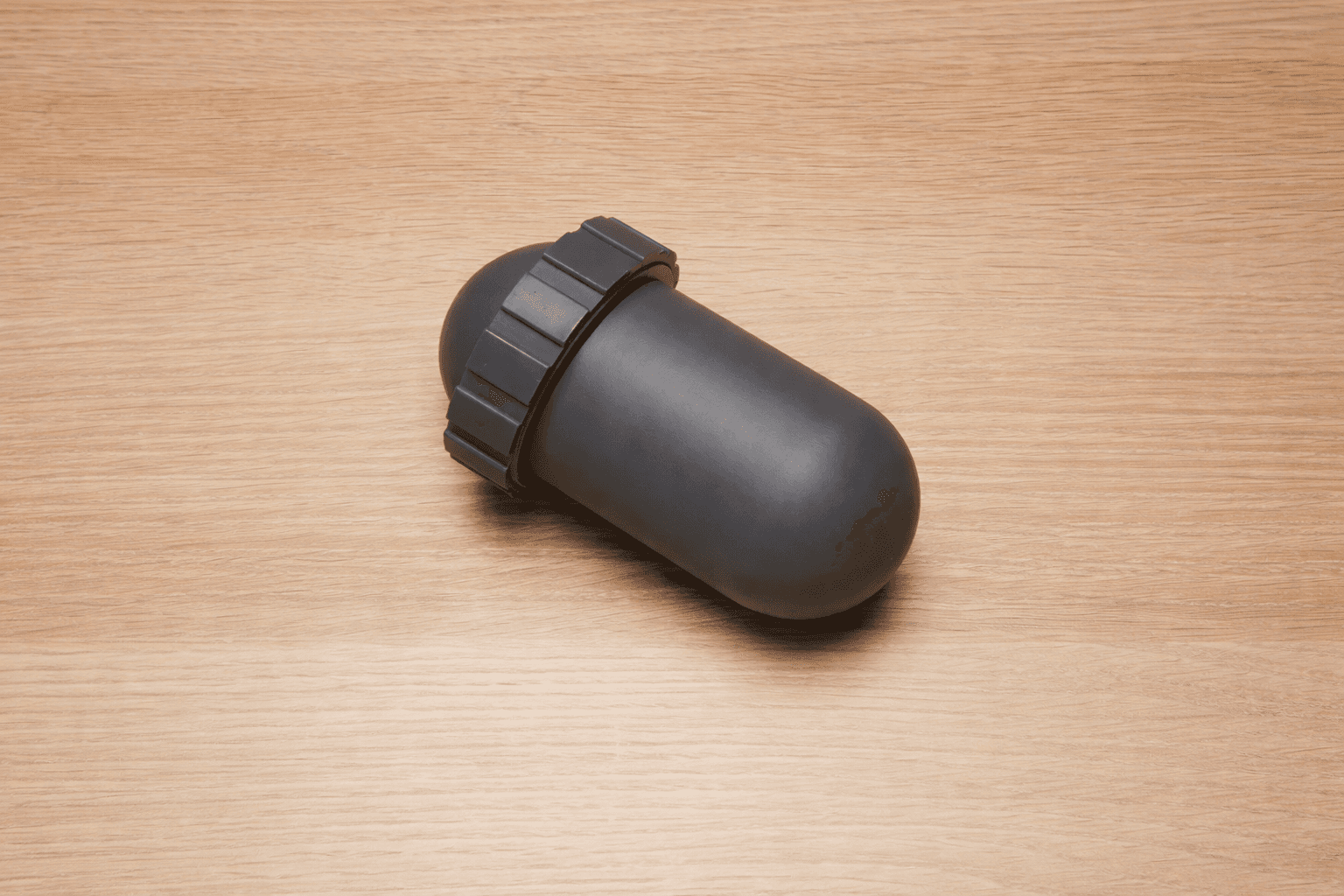
This is a case where we'd point directly to our own process rather than staying neutral, because it's an area we've built real, direct experience in: SLA enclosures for both surface vessel equipment and subsurface applications — a topic we've covered in more depth in our piece on 3D printed photopolymers in maritime applications. It's worth being clear that surface and subsurface use are genuinely different engineering problems, not the same challenge at two difficulty levels. Surface vessel equipment generally needs to resist spray, rain, and occasional wave splash — a meaningfully lower bar than sustained submersion. Subsea equipment — sensor housings, ROV components, anything that spends real time underwater — has to hold a reliable seal against continuous hydrostatic pressure, which is a different and much less forgiving problem.
SLA's low porosity, covered above, is a genuinely useful starting point for either case — but material alone doesn't make a subsea enclosure reliable. What actually closes the gap is sealing design built from hands-on experience: correctly specified gasket channels and O-ring grooves, potting where appropriate, and a design that's been proven against real submersion rather than assumed from a datasheet. We've also written specifically about salt water exposure and corrosion resistance for anyone working through the material side of a marine application.
If you're specifying an enclosure that needs to survive real water exposure, whether that's spray on deck or full submersion subsea, it's worth talking to someone who's actually built that specific kind of part before, not just printed a housing and hoped.
When you need an actual IP rating
It's worth separating "waterproof" as a casual description from a genuine, tested ingress protection rating — the same distinction we made when explaining what UL94 V-0 actually means versus an informal "flame retardant" claim. IP65, IP67, and similar ratings are earned through defined test procedures, not assumed from material choice or process alone. If a part genuinely needs to carry an IP rating rather than just perform reasonably well against moisture, that's a design and testing conversation worth having early, not an assumption to build in after the fact.
If you're working through a part that needs to hold water or resist moisture reliably — on deck or below the surface — it's worth talking through process and sealing strategy with a team that's done it before. We quote every job with transparent, published pricing and no minimum order quantity — head to the homepage whenever you're ready for a quote.