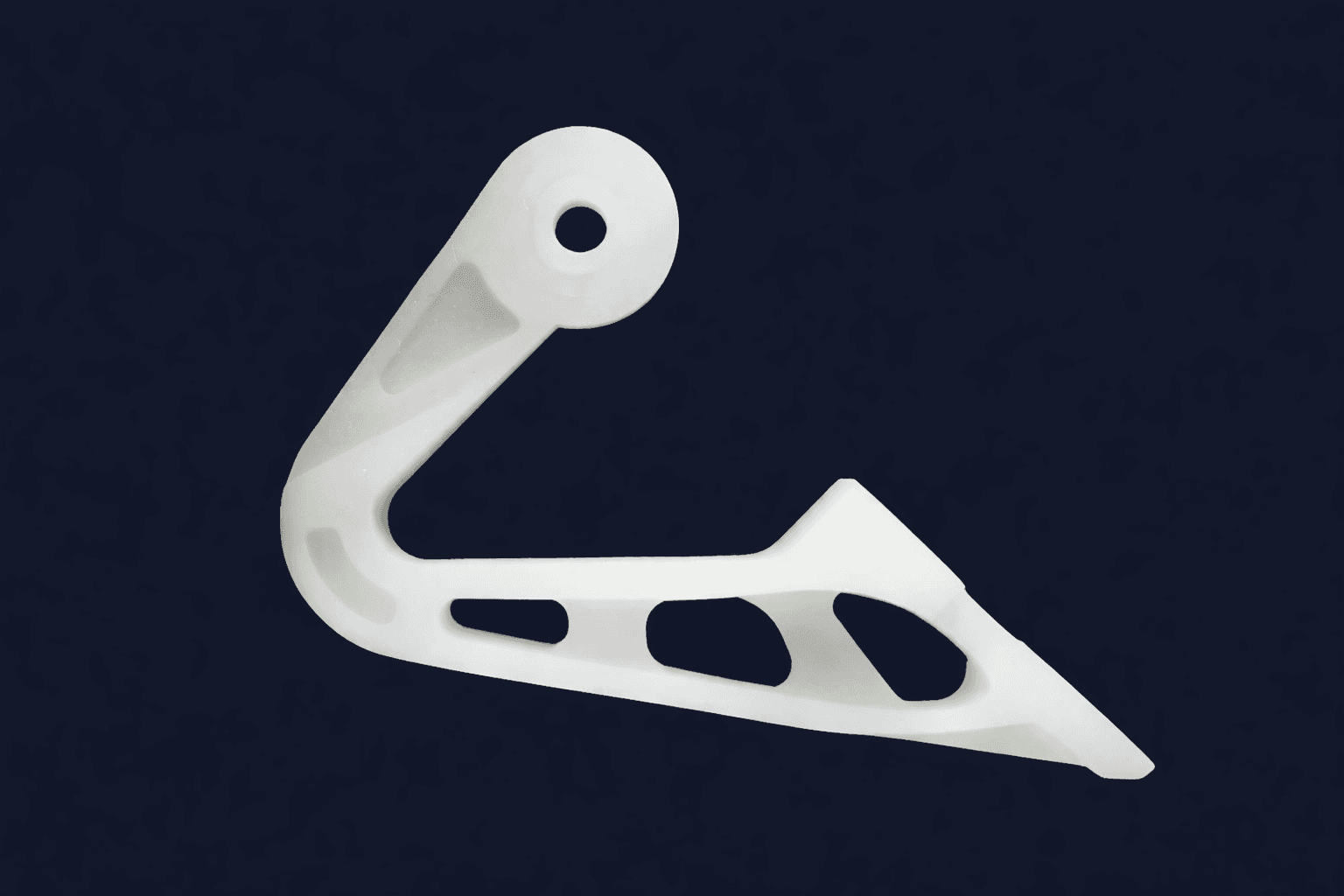
3D Printed Photopolymer Resins in Maritime

Author
Fionn O'Connell
Saltwater is one of the most punishing environments a part can live in. Chlorides, dissolved oxygen, UV, biofouling, and constant cyclic loading eat through metals and degrade many common plastics within months. For decades, the answer for subsea hardware has been marinised aluminium, stainless, or titanium. Heavy, expensive, and tied to long machining lead times.
That calculus is shifting. Stereolithography (SLA) and other vat-photopolymerisation processes can now produce fully dense, watertight parts in engineering-grade photopolymer resins, and they're showing up everywhere from AUV pressure housings to ROV thrusters to research-vessel spares printed underway.
This is a short tour of why photopolymer resins suit maritime work, where they're already being used, and where the limits sit.
Why polymers beat metal on corrosion
The headline advantage is simple: polymers don't rust. They're not electrochemically active in the way carbon steel or even some aluminium alloys are, so the galvanic and pitting corrosion mechanisms that dominate metallic failure in seawater largely don't apply. There's no sacrificial anode to maintain, no need for isolation bushings to keep dissimilar metals apart, and no surface treatment to chip and expose substrate.
This matters enormously for small, distributed hardware like sensor pods, junction boxes, camera enclosures, instrument fairings, where the cost and weight of a properly protected metal housing is wildly out of proportion to the electronics inside.
That said, "polymer" is not a free pass. Saltwater still degrades plastics through hydrolysis, UV-driven chain scission, and biofouling that can mechanically and chemically attack the surface. Performance in a marine environment depends heavily on the specific resin chemistry, how thoroughly the part is post-cured, wall thickness, and whether it's continuously immersed or only splash-exposed. A well-chosen, fully post-cured SLA part can run for years; a poorly cured one will craze and leach.
Why SLA specifically, and not FFF
Most consumer 3D printing is FFF (fused filament fabrication) — the familiar extruded-plastic process. FFF parts have layer lines that act as leak paths and stress concentrators, and they almost always need secondary sealing to hold pressure. SLA is different: each layer is cured photochemically into the layer below, so the part comes out as a single fused solid with no voids between layers. That's the property that makes it interesting for maritime work — you can print a sealed pressure housing in one piece and have it actually hold pressure straight off the build plate.
A 2019 NOAA study captured this neatly while testing SLA aboard a research vessel: SLA-printed parts are "particularly suited for underwater applications requiring sealed housings" because the process produces "high-resolution models that are fully solid and impervious to water," whereas hydrostatic pressure "can quickly compromise parts created using standard fused filament fabrication." The same project demonstrated SLA-printed pressure housings sealing successfully at 200 m depth — printed at sea, on a moving vessel, with no post-machining.
A worked example: the POP Housing
A nice public reference design is the Photopolymer Open-source Pressure (POP) Housing from the University of Rhode Island's Undersea Robotics and Imaging Lab. It's a compact SLA-printed pressure vessel with three parts: a main body, an end cap with a dash-226 O-ring groove, and a threaded collar that compresses the seal. The end cap is designed to be swapped or modified for different sensor payloads and cable pass-throughs, so a single main body can serve many missions.
The headline number is the depth rating: POP has been tested to 4,000 psi, roughly 2,600 metres of seawater. That's well past the continental shelf and into genuine deep-water territory, achieved with off-the-shelf SLA hardware and a Fusion 360 model anyone can fork. Internal volume is sized for something like a Raspberry Pi Zero and a small battery — exactly the scale of payload where machining a custom titanium housing makes no economic sense.
POP is worth pointing at because it short-circuits an entire procurement debate. The CAD is open, the print orientation files (.form) are published, and the design has real test data behind it. For an engineer scoping a low-cost AUV, sensor float, or instrument drop, it's a credible starting point rather than a marketing claim.
Where else this is showing up
POP is one project among many. A few that map well onto commercial maritime work:
Southern Ocean Subsea (SoSub) builds custom ROVs using Formlabs SLA printers and has reported subsea enclosures in Rigid 10K, Tough 2000, and Grey resins running to several hundred metres depth including a 3D-printed enclosure for an off-the-shelf server that operated at 600 m. Their argument is straightforward: machined or injection-moulded subsea enclosures cost thousands and ship in weeks, while a printed equivalent costs tens of dollars and ships the same day. For a small-volume robotics business that's not a marginal improvement, it's the difference between being able to take the job and not.
QYSEA has used powder-bed 3D printing for protective covers on the FIFiSH V6 ROV. Dive Technologies (now part of Anduril) prints structural and hydrodynamic elements of the DIVE-LD large-displacement AUV. ecoSUB Robotics builds its ecoSUB AUV body almost entirely from printed parts. Across these examples the pattern is the same: complex geometries, low to medium volumes, fast iteration cycles, and tolerance for unit cost in exchange for tooling-free flexibility.
Beyond housings, the same processes produce custom cable fairings, sensor mounts, antifouling fixtures, propellers and impellers for low-load applications, training and presentation models, and one-off spares for vessels under way. NOAA's at-sea SLA work was partly motivated by the cost of carrying a full inventory of spares versus the ability to print one on demand.
Choosing a resin for the application
Not every photopolymer is fit for continuous immersion. The variables that matter most:
Water absorption. Lower is better. Standard "tough" or "durable" resins tend to absorb more water than rigid engineering resins, which softens parts over time and can compromise dimensional accuracy on sealing surfaces.
Post-cure quality. Under-cured resin leaves unreacted monomer that leaches into water and weakens the part. A properly specified post-cure cycle (time, temperature, wavelength) is non-negotiable for marine parts.
Mechanical envelope. Rigid 10K-class resins (glass-filled photopolymers) are stiff and creep-resistant good for pressure housings under sustained load. Tougher resins handle impact better but creep more.
UV stability. Topside parts exposed to sunlight need a UV-stable resin or a coating; many photopolymers continue to react and embrittle with prolonged UV exposure.
Biofouling. Smooth, low-energy surfaces foul more slowly, but no untreated polymer is genuinely antifouling. For long deployments, plan for periodic cleaning or a sacrificial coating.
For most subsea housing work, the path of least resistance is a rigid engineering resin, full thermal post-cure, generous wall thickness around sealing features, and O-ring grooves printed in the orientation that keeps the sealing face off the build plate.
What this means if you're scoping a maritime part
If you've been quoting machined aluminium or titanium for a low-volume subsea component like sensor housings, instrument fairings, cable management, custom brackets, prototype AUV bodies then SLA in the right resin is almost certainly worth a costed comparison. The realistic gains are shorter lead times measured in days rather than weeks, unit costs an order of magnitude lower in small batches, design freedom for geometries you couldn't economically machine, and no corrosion programme to maintain.
The realistic trade-offs are lower allowable stresses than metals, sensitivity to UV and temperature, and a need to validate each design rather than trust generic datasheet numbers.
If you'd like a printed prototype of a housing, fairing, or enclosure to take pressure-vessel testing or just a costed comparison against your current machined part get in touch. We print in marine-suitable photopolymer resins and can advise on orientation, post-cure, and sealing-feature design before the first part comes off the build plate.
Further reading: the POP Housing repository (URI Undersea Robotics and Imaging Lab), Formlabs case studies on Southern Ocean Subsea and deep-ocean enclosures, and the NOAA paper on at-sea SLA printing.