Why SLA Printed Resins are Quietly Reshaping Drone Design

Author
Fionn O'Connell
For UAV designers, every gram matters. Every millimetre of frontal area matters. And in a market where iteration speed often decides whether a platform reaches the customer first, every week saved in prototyping matters too. Stereolithography (SLA) and its close cousins (DLP, MSLA) sit at an unusually useful intersection of all three constraints and that is why a growing number of drone teams, from hobbyist racers to defence-grade ISR developers, are turning to photopolymer resin printing for both prototypes and end-use parts.
This post walks through where resin printing earns its place on a drone, the design freedoms it unlocks, and where it fits alongside (rather than against) the other tools in a UAV engineer's kit.
The lightweighting case
Drones live and die by their thrust-to-weight ratio. Shaving 20 grams off a 600 g quadcopter is a measurable bump in flight time, payload capacity, and agility. Modern engineering photopolymer resins make that kind of saving practical:
Tough, glass-filled, and carbon-reinforced resins now offer specific stiffness comparable to glass-filled nylons, with the bonus of much finer feature resolution.
High-temperature resins (HDT > 200°C) survive next to ESCs, motor mounts, and even small combustion or hybrid powertrains.
Flame-retardant and UV-stable formulations are increasingly viable for outdoor and regulated applications.
Compared to milled aluminium or even injection-moulded ABS housings, a properly designed SLA part can be a fraction of the mass for the same stiffness — because the printer doesn't care how complex the internal geometry is.
Low tooling cost, fast iteration
Injection moulding a custom canopy, gimbal housing, or antenna fairing typically means £5,000–£30,000 in tooling and 6–10 weeks of lead time before the first shot. For a drone startup iterating on aerodynamics or sensor placement weekly, that is a non-starter.
SLA has effectively zero tooling cost. The "tool" is a CAD file. That means:
New revisions land in days, not months.
Small production runs (10–500 units) become economically sensible.
Mission-specific variants, a thermal-camera nose for one customer and a LiDAR nose for another, cost the same per part.
For a service bureau customer, this often translates to running A/B aerodynamic tests on physical hardware in the same week the CAD is finalised. That kind of feedback loop is genuinely difficult to match with any other manufacturing route at comparable surface quality.
Topology optimisation: where SLA really earns its keep
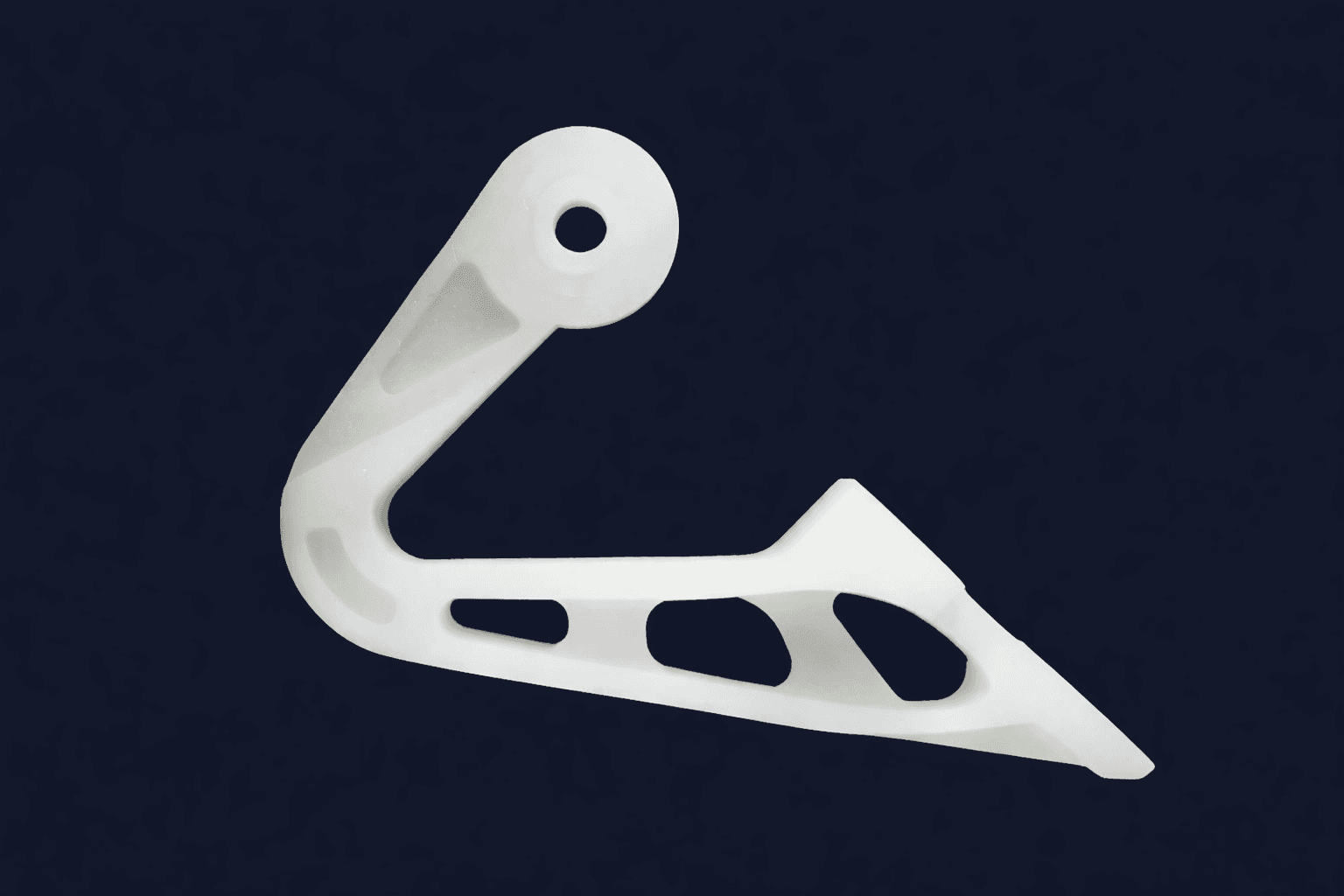
This is the part many drone teams underuse. Topology-optimised geometries — the organic, bone-like structures generated by solvers in nTopology, Fusion 360 Generative Design, Altair Inspire, or Ansys Discovery — are notoriously awkward to manufacture conventionally. Five-axis machining can sometimes do it, at enormous cost. Casting is a non-starter for low volumes.
SLA, by contrast, can print these geometries natively, with feature resolutions down to roughly 25–50 microns. Combined with lattice infill and variable-density internal structures, this enables some genuinely powerful patterns for UAV parts:
Motor arms with internal lattices that retain bending stiffness while removing 30–50% of mass.
Camera and payload mounts tuned to damp specific vibration frequencies rather than just "be stiff".
Aerodynamic fairings with smooth, draft-free external surfaces that would require complex split tooling to mould but print as a single piece.
Internal ducting for cooling airflow over ESCs or batteries, integrated directly into the structural part rather than bolted on.
The drag reduction angle is worth dwelling on. Conventional manufacturing constraints (draft angles, parting lines, minimum tool radii) force compromises on external aerodynamic surfaces. SLA simply doesn't have those constraints. Smooth NACA-profile fairings, integrated propeller shrouds, and continuous-curvature canopies all become routine. For fixed-wing UAVs and long-endurance multirotors, where parasitic drag eats directly into endurance, this is not a small thing.
Other techniques SLA plays well with
A few design strategies that resin printing makes notably easier:
Part consolidation. Brackets, standoffs, cable guides, and mounting features that would normally be separate components can be combined into a single printed part. Fewer fasteners, lower assembly time, less weight.
Hollowing with internal ribbing. Print a thin-walled shell with strategic internal stiffening; you get a part that behaves like a much heavier solid one.
Compliant mechanisms. Living hinges and snap-fits print well in tougher resins, removing screws and inserts from canopies and battery doors.
Conformal cooling and ducting. Channels that follow the contours of heat-producing components are trivial to design and impossible to mould.
Where this is already happening
A few reference points worth knowing about:
NASA has used SLA and other AM processes for cube-sat structures and Mars helicopter (Ingenuity) prototype components, taking advantage of mass savings on flight-critical parts.
Various defence primes and Tier-1 UAV manufacturers publicly use resin printing for ISR payload housings, antenna radomes, and gimbal components.
Drone delivery startups routinely print aerodynamic shells, propeller guards, and parcel-handling mechanisms in engineering resins for both prototype and limited-production fleets.
FPV and racing communities have been early adopters of TPU and tough-resin printed parts for camera mounts, antenna holders, and crash-zone components.
When SLA isn't the right answer
A balanced view: SLA is not a universal answer. For parts that must survive sustained high-cycle fatigue, large primary structural members, or extreme impact, sintered nylon or carbon-filled FDM may still win.
SLA is exceptionally strong for complex, low-to-mid-volume, geometry-driven parts which describes a surprisingly large fraction of a modern drone's BoM.
Closing thought
For UAV engineers, the question is rarely "is 3D printing good enough?" anymore. It's "which process is right for this specific part?" Photopolymer resin printing, used thoughtfully alongside topology optimisation and lattice design, has become one of the highest-leverage tools available for reducing weight, cutting drag, and getting drones into the air faster.
If you're working on a UAV platform and want to talk through where SLA might fit on your bill of materials we'd be glad to take a look at your CAD and suggest the right resin and design approach.