How Is 3D Printing Used in Aerospace? A Realistic Breakdown

Author
Fionn O'Connell

"Aerospace" gets used as if it's one manufacturing environment, but it isn't. Large commercial and military airframes sit under a heavy, slow-moving certification regime where primary structure is dominated by qualified metal powder bed fusion and conventional composite or machined parts. UAV and drone platforms are a different world entirely — faster iteration, different certification burdens, and a lot more freedom in what process actually ends up in the finished aircraft. 3D printing shows up differently across that whole spectrum, and SLA resin specifically plays a real role in more of it than most overviews give it credit for — including, in some cases, as actual flight hardware.
Specialty flight hardware and inserts — where resin reaches real aircraft
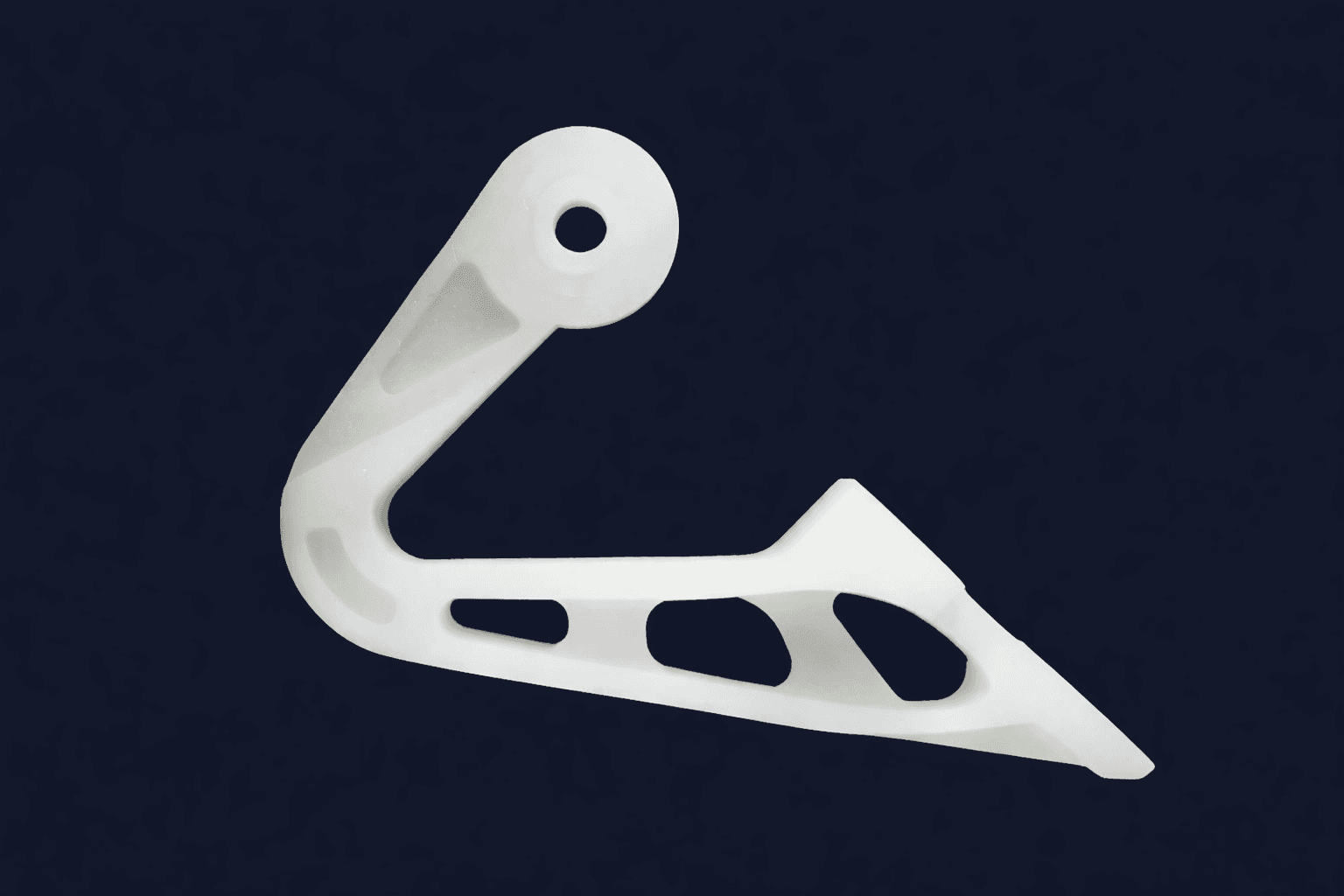
The most direct role resin plays in aerospace isn't prototyping — it's specialty flight parts and the hardware that integrates into them. On UAV platforms in particular, both metal powder bed fusion and SLA resin get used for finished flight components, precisely because both processes offer geometric freedom that conventional manufacturing can't match: organic mounting geometry, internal channels, and lightweighted structure that would be impractical to machine or mould.
A concrete example from our own work: threaded inserts bonded into EPP (expanded polypropylene) foam moulded fuselage and wing structures are genuine flight hardware on production drones — carrying real mounting and load-transfer duty as part of the finished aircraft, not a stand-in for a "real" part made some other way. It's a good illustration that resin's role in aerospace isn't confined to the design process; sometimes it's integrated directly into what actually flies. We'll cover that specific process in more depth in a dedicated article.
Investment casting patterns — resin inside metal flight parts
There's a second, less obvious way resin ends up inside a certified flight part: as a casting pattern rather than the final material. Investment (lost-wax) casting traditionally uses machined wax patterns to form the mould cavity for casting superalloy or titanium components — brackets, manifolds, small structural fittings. SLA resin patterns, printed to burn out cleanly during the casting process, can replace or supplement machined wax tooling, particularly for low-volume or design-iterating parts where cutting new wax tooling for every revision isn't practical. The resin itself doesn't survive the process, but the metal part that comes out the other side has gone through normal aerospace material qualification — it's a real contribution to a real flight part, just an indirect one.
Rapid design iteration and fit checks
Away from finished hardware, resin printing earns its keep in the design process itself. Before a bracket, duct, or housing gets machined or cast in its final material, engineering teams typically want a physical fit check: does it clear the adjacent harness, does the connector orientation work, does the mounting boss line up with the airframe. Machining or casting a test article for this purpose is slow and expensive relative to the question being asked. A same-week SLA print of the exact geometry, in a material stiff enough to represent real assembly tolerances, answers the fit-check question without committing to production tooling — removing weeks from every design iteration.
Jigs, fixtures, and composite layup tooling
Composite manufacturing — a large part of modern airframes — depends heavily on drill jigs, layup mandrels, and assembly fixtures. These parts don't fly, but they need to be dimensionally accurate, often need to survive some thermal exposure near curing composite layups, and get made in low volumes specific to one aircraft programme. That's a strong match for resin printing: no tooling cost, fast turnaround on a fixture revision, and access to higher-temperature resins for tooling that sits near, if not in, a curing process.
Ground support equipment
Ground support equipment — test rig brackets, cable routing clips, protective covers, ergonomic handling tools used on the hangar floor — typically doesn't carry the certification burden that flight hardware does, which makes it another practical, if overlooked, use of resin printing: low-volume, functional hardware that would otherwise be machined or moulded for a very small production run.
The line for large commercial and military airframes
For large commercial and military aircraft specifically, primary structure — anything carrying real flight loads on that scale of platform — is still the domain of qualified metal powder bed fusion, casting, or conventional composite and machined structure, and that isn't changing soon; the certification pathway for a new material or process at that level is long and expensive by design. But that's a statement about one segment of aerospace, not a ceiling on what resin printing does across the industry as a whole. Between UAV flight hardware, casting patterns, tooling, and ground support equipment, SLA resin has a genuine and growing footprint in getting aerospace programmes — of every size — into the air.
If you're working through a prototype, fixture, casting pattern, or flight-ready UAV component and need a fast turnaround without committing to production tooling, that's exactly the kind of job resin printing is suited to. We quote every job with transparent, published pricing and no minimum order quantity — head to the homepage whenever you're ready for a quote.