Why Is EPP Foam Used in Drone Fuselages? (And How SLA Inserts Make It Structural)

Author
Fionn O'Connell

What EPP foam is, and why drones use it
Expanded polypropylene (EPP) is made by fusing pre-expanded polypropylene beads together under heat and steam inside a mould — the same family of process as EPS (the foam in disposable coffee cups and packaging), but with a key difference: EPP is tough and resilient rather than brittle. Where EPS crumbles and cracks under impact, EPP compresses and largely returns to shape, which is exactly the property that matters for a drone airframe. A handful of properties make it a near-default choice for FPV and RC drone fuselages specifically:
Crash resilience. Drones — especially FPV and racing platforms — crash constantly during development and use. EPP absorbs impact energy without shattering, and a dented fuselage is often still flyable.
Very low density. Typical fuselage-grade EPP sits somewhere in the 20–60 kg/m³ range, which is a meaningful fraction of the aircraft's total weight budget saved before a single gram of avionics goes in.
Cheap tooling for volume production. Once a mould exists, EPP parts are fast and inexpensive to produce in quantity — a real advantage for anyone building more than a handful of airframes.
Vibration damping. Foam absorbs motor and propeller vibration far better than a rigid shell would, which matters for camera stabilisation and electronics longevity.
The structural problem EPP foam creates
The properties that make EPP good at crash absorption are the same properties that make it useless for anything requiring precision or a hard interface. It's a soft, low-modulus, intentionally crushable material — it can't hold a fastener, can't maintain a repeatable channel geometry, and can't provide a clean pass-through without degrading over time. Almost every functional feature on a fuselage beyond the outer shape needs something other than foam doing the actual work.
What rigid inserts actually get used for
This is a wider list than "mounting points," and it's worth being specific about it:
Mounting points. Motor mounts, arm sockets, servo mounts, battery strap anchors, and payload bay latches all need to transfer real load — something foam alone crushes under rather than holds.
Air channels. Cooling airflow paths for ESCs and motors, or pressure-sensing lines, need a dimensionally consistent, sealed channel. Foam alone can't maintain a clean bore, especially where a channel crosses a structural rib, and it can shed particulate into the airflow over time. A printed channel liner keeps the passage accurate and clean for the life of the airframe.
Wire harness routing. Sensor and power wiring can be routed internally through the foam body between compartments via a printed channel or grommet, rather than taped or zip-tied along the outside of the fuselage. External cable runs add drag, create a snag point, and are one of the first things that gets damaged in a crash — internal routing through a defined exit point avoids all three.
Sensor and optical mounts. GPS masts, pitot tubes, and FPV camera mounts often need a repeatable angular tolerance that foam simply can't hold on its own.
Hatch and latch frames. A payload bay or access hatch needs something rigid to latch against — a compressible foam edge won't hold a reliable closure over repeated use.
Where SLA-printed inserts solve it
There are two broad ways these inserts get integrated into an EPP fuselage:
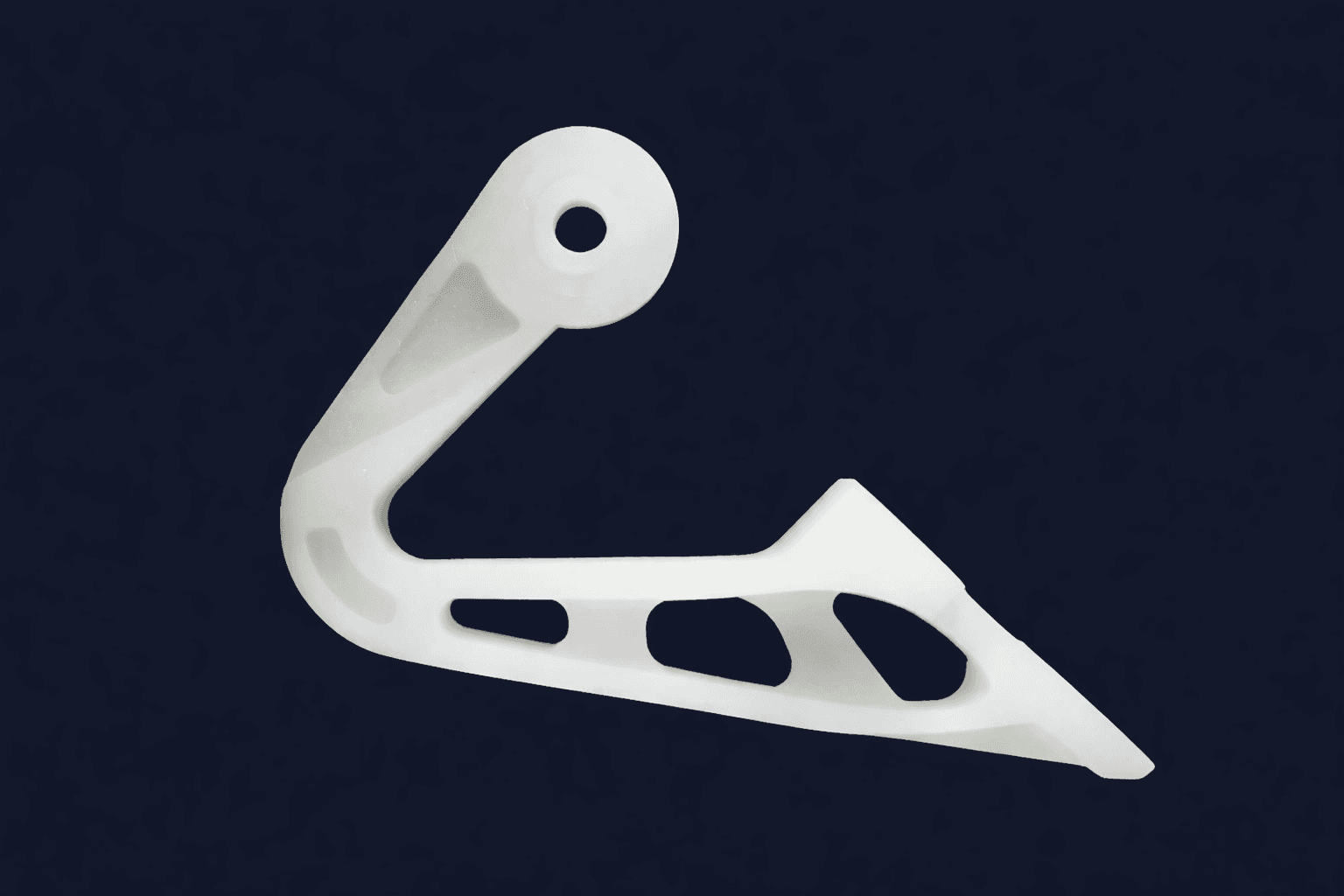
Pre-mould insertion, where the SLA insert — typically designed with flanges or undercut geometry — is placed directly into the EPP tool cavity before the bead-fill and steam cycle, so the foam fuses and locks around it during moulding rather than being bonded in afterwards.
Post-mould bonding, where a pocket is formed or cut into the finished EPP part and the SLA insert is bonded in separately, which gives more flexibility for late-stage design changes but shifts the difficulty onto the adhesive bond.
That second route is harder than it sounds, because polypropylene is chemically inert to most structural adhesives — it's a low-surface-energy plastic that very few glues wet properly without surface treatment (typically plasma or flame treatment, or a specific primer). Get that step wrong and the insert bond fails quietly, well before it fails obviously.
Why this combination works so well
The real value of pairing EPP with SLA inserts is that each material only has to do the job it's actually good at. The foam handles crash-energy absorption, weight, and bulk shape at low tooling cost; the resin inserts handle every precision feature — load paths, channels, alignment points — that EPP moulding simply can't achieve at usable tolerance. Moulded foam tolerances are loose by design, often ±0.5–1 mm or worse, while SLA holds tolerances an order of magnitude tighter.
There's a practical secondary benefit too: because the inserts are discrete components rather than moulded-in metal, a fuselage that's taken impact damage can sometimes be repaired around its existing hard-points instead of being scrapped — a real consideration for anyone operating a fleet rather than a single airframe.
Why few suppliers actually do this well
This isn't a process you can bolt together from generic "3D printing" and "foam moulding" capability separately. It requires coordinating two manufacturing processes with genuinely different tolerance behaviour and thermal characteristics — an insert design that accounts for the steam-forming cycle it'll sit through if it's placed pre-mould, correct flange and undercut geometry for real pull-out resistance, and, for bonded inserts, an actual answer to the polypropylene adhesion problem rather than hoping a generic epoxy holds. It's mechanical engineering at the interface of two processes, not a feature of either one alone — which is a large part of why it stays a small, specialist corner of the drone manufacturing world rather than something every 3D printing shop offers.
What to think about if you're specifying this
If you're designing an EPP fuselage with integrated hardware, the decisions that matter most are usually made earlier than people expect: whether to go pre-mould or post-mould (this changes your EPP tooling design, so it's not a late-stage swap), what each insert actually needs to do — load, airflow, wiring, or alignment — and, if you're bonding post-mould, planning for polypropylene surface treatment from the start rather than discovering the adhesion problem after a failed pull test.
It's a niche capability, and we're one of a small number of suppliers who've actually built the process knowledge to do it properly rather than treating it as an afterthought. If you're working on an EPP airframe and need hardware designed for the process rather than adapted to it, we quote every job with transparent, published pricing and no minimum order quantity — head to the homepage whenever you're ready for a quote.