Can You 3D Print a Drone Frame? Material Comparison for FPV and Commercial Builds

Author
Fionn O'Connell

Yes, and it's often standard practice
3D printed drone frames are the norm, not the exception, across most of the FPV and small commercial UAV market. Worth being precise about terminology first: a "frame" here means the rigid chassis, the arms and centre plate that hold the motors, ESCs, flight controller, and battery on a multirotor, which is a different part of the aircraft to a fixed-wing fuselage shell. Hobbyists routinely design and print their own frames, and plenty of commercial frame manufacturers use 3D printing for at least part of the structure, whether that's the full arm-and-plate assembly or printed components bolted to a carbon fibre plate.
The material landscape for printed frames
FDM materials dominate frame printing today, and for good reason:
Carbon-fibre-reinforced nylon (Nylon-CF, Onyx, and similar) is the closest thing to a gold standard — it combines genuine impact toughness with a good stiffness-to-weight ratio, and critically, it tends to flex and absorb a crash rather than shatter.
PETG-CF is a cheaper, stiffer alternative, though some formulations trade away some of nylon's crash toughness for that extra rigidity.
PLA, despite being the easiest material to print and the one most beginners reach for first, is a poor choice for anything beyond an initial test frame — it's brittle, has low heat resistance near motors and ESCs, and cracks on impacts that CF-nylon would shrug off.
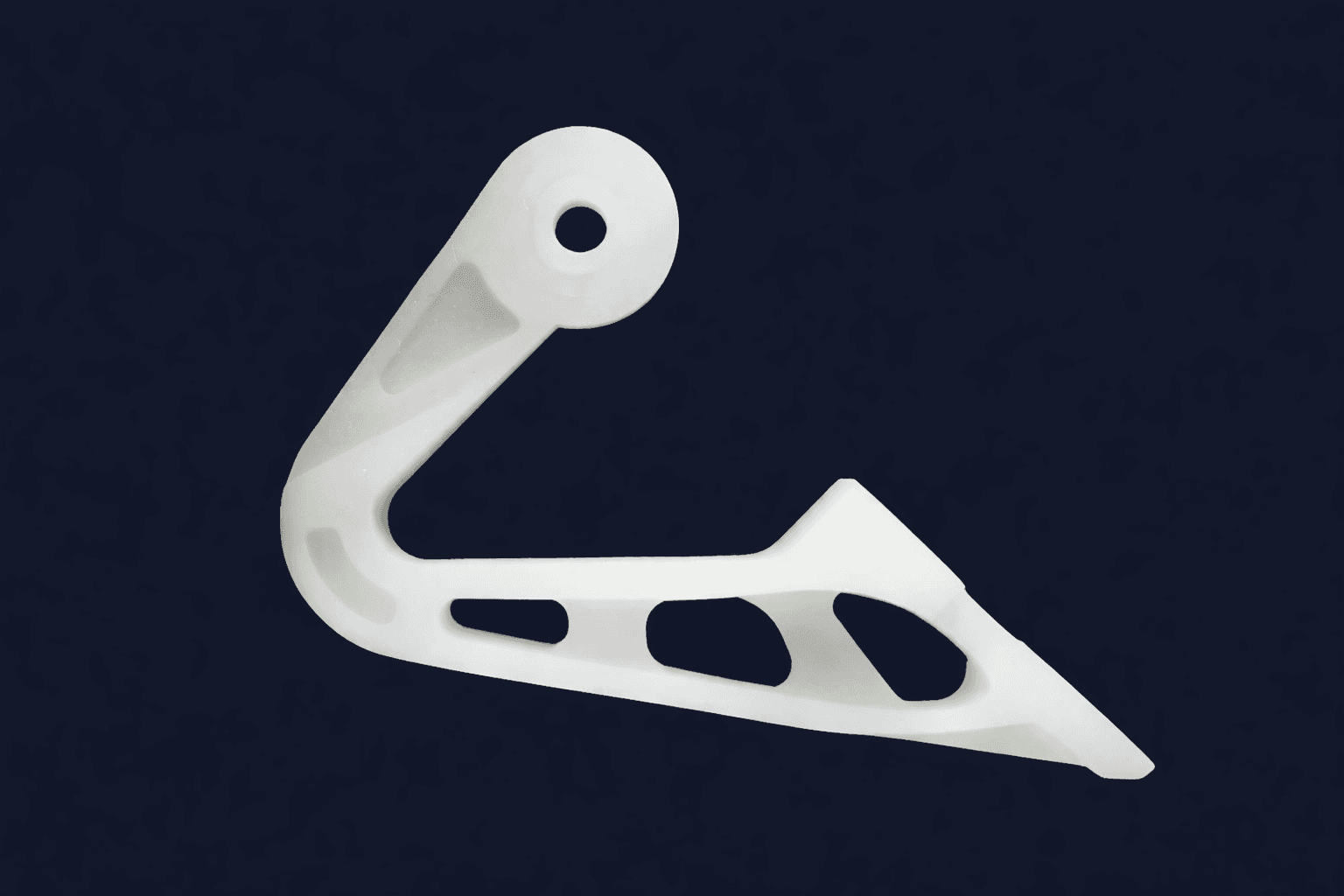
SLA/resin materials have historically been less common for full frames, mostly because early-generation resins were genuinely too brittle for repeated crash impact. That's changed with modern tough and glass- or carbon-fibre-filled engineering resins, which close much of that gap, but it's worth being honest about where resin fits best rather than overselling it: for a large frame arm taking direct, repeated impact at high production volume, CF-nylon via FDM often remains the better call. Where SLA earns its place is in smaller structural components and reinforced sections, camera mounts, antenna mounts, standoffs, and anywhere the part integrates threaded inserts, where tight tolerances and fine feature resolution matter more than raw impact toughness on a full-size arm.
A hybrid approach is also extremely common in real builds: a CNC-cut or laser-cut carbon fibre plate for the main 2D frame body, paired with 3D printed (FDM or SLA) components for the 3D geometry a flat plate can't do, arm ends, camera mounts, battery straps, antenna posts. This isn't a compromise; it's often the better engineering answer, using each process for what it's actually good at.
What actually matters when choosing
Rather than picking a material by name, it's worth choosing against the properties that actually determine whether a frame survives:
Impact toughness. The single most important property for anything that will crash - which, for a drone frame, is a when, not an if. A material that flexes and absorbs energy beats one that's simply stiff.
Stiffness-to-weight. Too much flex in an arm introduces vibration that reaches the flight controller's gyro, degrading flight performance well before the frame actually breaks.
Vibration damping. Related but distinct from stiffness, some materials transmit high-frequency motor and prop vibration more than others, which matters for both flight performance and camera stability.
Heat resistance near motors and ESCs. ESCs in particular can run hot enough to soften a low-HDT material over time, especially in an enclosed or tightly packed frame.
Fastener and insert compatibility. Frames get disassembled constantly, for repairs, component swaps, and battery changes, so a material that holds a fastener reliably over many cycles matters more here than on most printed parts. This is exactly where bonded threaded inserts earn their keep over screwing directly into plastic.
The honest recommendation
If you're printing a full-size frame arm that needs to survive repeated hard crashes at the lowest possible weight, CF-nylon via FDM is still the sensible default, and we won't pretend otherwise. Where we come in is the rest of the frame: precision components, mounts, standoffs, insert-bearing brackets. Where tolerance, repeatability, and clean insert integration matter more than outright crash toughness on a full arm, and where low-volume or design-iterating production makes SLA's zero tooling cost a real advantage over injection moulding.
If you're working through a frame design and aren't sure which components should be FDM, resin, or plate, it's a conversation worth having before committing to a full print. We quote every job with transparent, published pricing and no minimum order quantity head to the homepage whenever you're ready for a quote.