How Is 3D Printing Used in Robotics?

Author
Fionn O'Connell

Rapid iteration on custom hardware
Robotics development involves a huge amount of custom, non-standard hardware — brackets, sensor mounts, cable management, structural links — much of which changes repeatedly as a design matures. Machining or moulding each revision is slow and expensive relative to the iteration speed robotics teams actually need. A same-week SLA print of a bracket or mount revision keeps development moving without committing to production tooling before the design has settled.
End-effectors and grippers
Gripper fingers, custom jaw geometry, and end-effector components are a strong fit for precision printing, because the interface geometry — where the gripper actually contacts the object it's handling — is often the entire engineering problem. Fine feature resolution and tight tolerances matter more here than raw production volume, which plays to SLA's strengths directly.
Sensor and electronics housings
Robots are typically dense with sensors, cameras, and electronics that need low-volume, custom-fit housings — often one specific shape per robot variant rather than a mass-produced enclosure. That's a poor fit for injection moulding's tooling economics and a good fit for 3D printing's zero tooling cost, particularly where connector cutouts and mounting bosses need to be dimensionally accurate straight off the printer.
Lightweight structural components
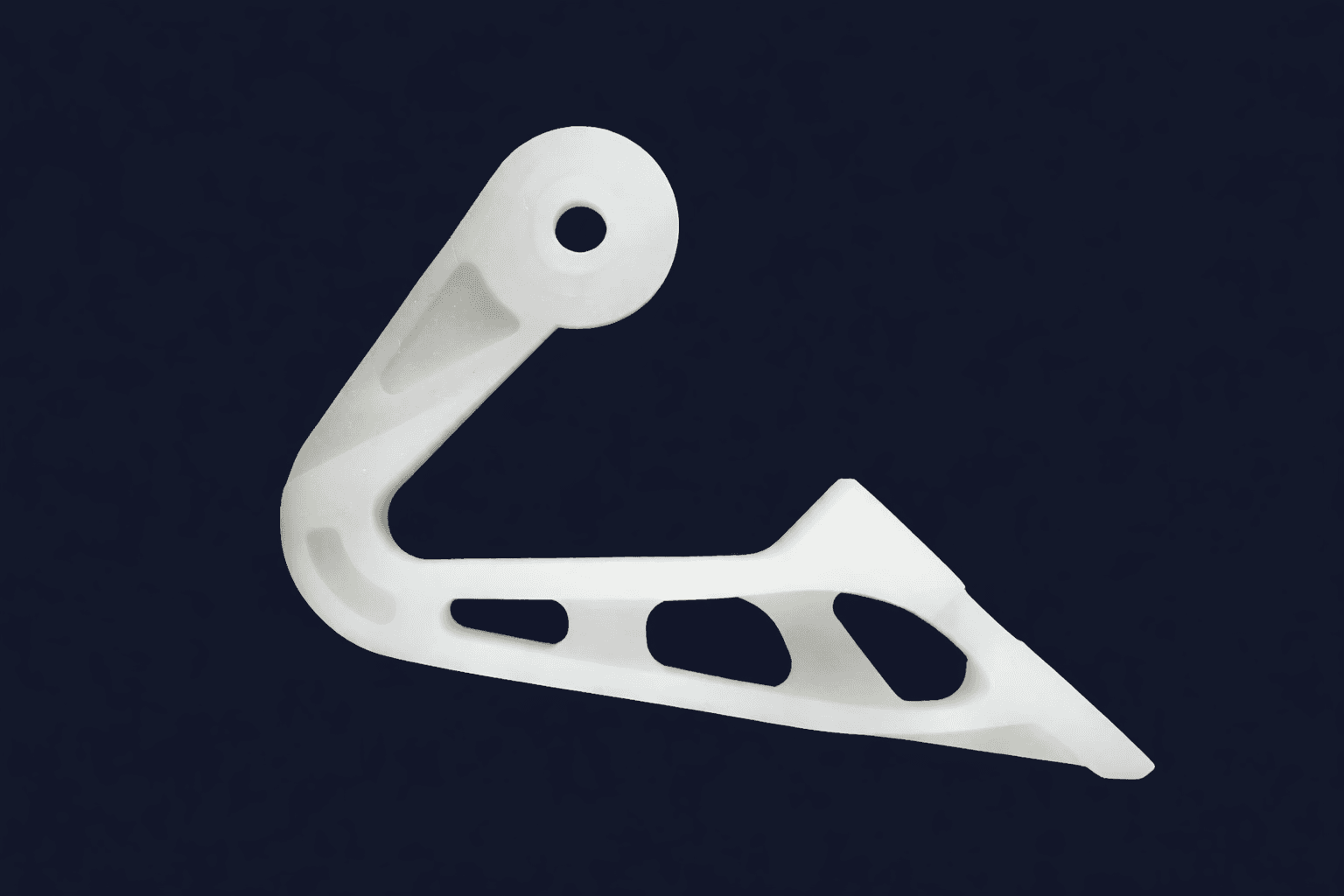
Weight matters in mobile and legged robotics much the way it matters in drones — every gram affects battery life, payload capacity, and dynamic performance. Structural links and housings printed in an appropriately strong engineering resin (our 50MPa Tough Engineering Resin is a common starting point for this kind of part) can hit a stiffness-to-weight ratio that's difficult to match with off-the-shelf stock material machined to shape.
Where it fits into a robotics programme
3D printing shows up across the whole development cycle in robotics — from early rapid-iteration prototypes through to low-volume production components — precisely because robotics rarely involves the kind of high-volume, unchanging part that favours traditional tooling.
If you're working through custom robotics hardware and want to know whether a part is better suited to printing or another process, that's a conversation worth having early. We quote every job with transparent, published pricing and no minimum order quantity — head to the homepage whenever you're ready for a quote.